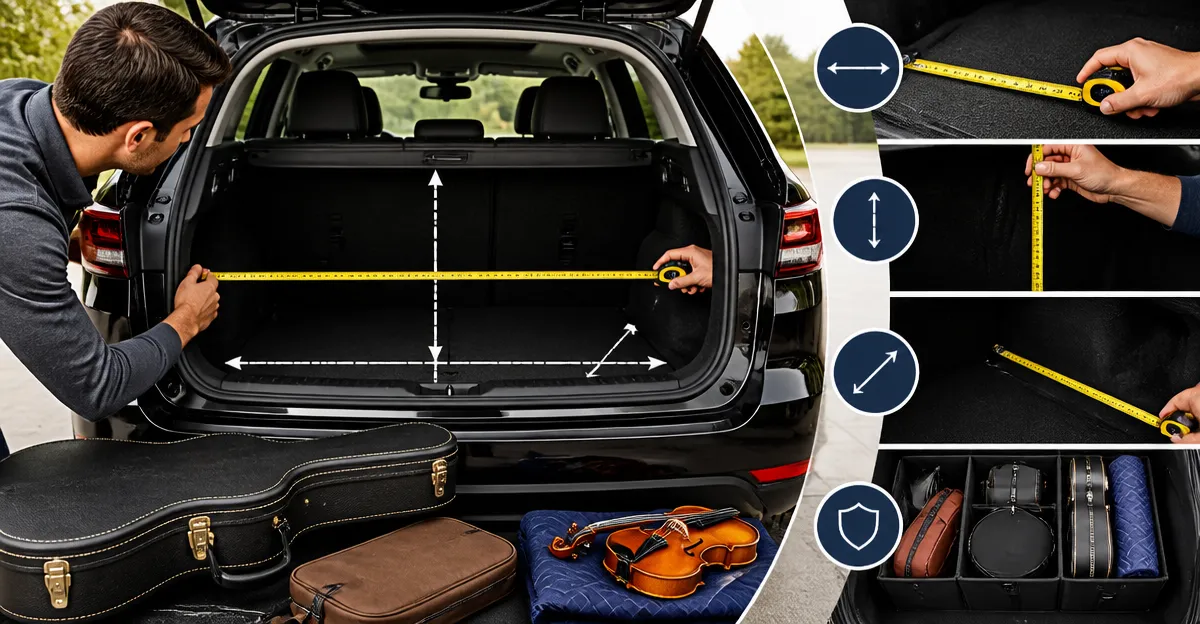
How to Measure Trunk Space for Transporting Musical Instruments: A Step‑by‑Step Guide to Fit and Protect Your Gear
Introduction
One will discover a systematic approach to determine whether a vehicle trunk can accommodate a guitar, violin, or keyboard without compromising safety. The guide explains why accurate measurements prevent damage, reduce shifting, and improve overall travel efficiency. Readers will also learn how to select an organizer that maximizes space while providing cushioning and ventilation. By following each step, one can travel confidently with valuable musical equipment.
What You'll Need
- Measuring tape or retractable steel ruler
- Pen and notebook for recording dimensions
- Soft protective blankets or foam padding
- Adjustable straps or bungee cords
- YOREPEK 2‑Layer Golf Trunk Organizer – sturdy, ventilated compartments for shoes and accessories
- Femuar 72L Collapsible Car Trunk Organizer – high‑capacity, waterproof storage with non‑slip bottom
- AUTOPTIM Collapsible Trunk Organizer – compact, multi‑pocket design with Velcro hold‑in‑place system
- JiatuA Adjustable Collapsible Trunk Organizer – reinforced dividers and universal fit
Step 1: Clear the Trunk and Prepare a Baseline
The first action is to empty the trunk completely, removing any cargo, spare tire, or floor mats that could affect measurements. One should place a clean, flat surface such as a large cardboard sheet to protect the trunk floor and to serve as a reference plane. This baseline ensures that subsequent dimensions are taken from a consistent level, avoiding errors caused by uneven surfaces. At this stage, a sturdy organizer such as the YOREPEK 2‑Layer Golf Trunk Organizer can be positioned temporarily to verify that the trunk can hold a full‑size container without obstruction.
Step 2: Measure Length, Width, and Height
Using a measuring tape, one should record the interior length from the rear bulkhead to the front edge of the passenger seat, noting any curvature that reduces usable space. Next, measure the width between the left and right wheel wells at the narrowest point, then repeat the measurement at the widest point to capture the full span. Finally, measure the vertical height from the floor to the lowest point of the trunk lid, accounting for any protruding wheel arches. Document each figure in centimeters and inches for reference; this dual notation assists when consulting instrument case specifications that may list dimensions in either system.
Step 3: Identify Obstructions and Adjust Measurements
Many vehicles feature built‑in features such as spare tire wells, rear‑seat fold‑down mechanisms, or cargo nets that intrude into the trunk volume. One must measure around these obstacles, subtracting their occupied space from the total interior dimensions. For example, a spare tire well that occupies 15 cm of depth reduces the effective length for a guitar case. Recording these adjustments prevents the common mistake of assuming the entire trunk is usable, which can lead to cramped placement and potential damage.
Step 4: Compare Instrument Case Dimensions
With the trunk dimensions recorded, retrieve the exact measurements of the instrument case, typically found on the manufacturer's specification sheet or on the case label. Compare the case length, width, and height against the adjusted trunk dimensions, ensuring that each dimension of the case is smaller than the corresponding trunk measurement. If the case is marginally larger in one dimension, consider rotating the case diagonally; the diagonal space often exceeds the simple rectangular dimensions.
Step 5: Select an Appropriate Trunk Organizer
Choosing a trunk organizer that fits the measured space while providing protection is critical. The Femuar 72L Collapsible Car Trunk Organizer offers a 72‑liter capacity, waterproof 600D Oxford cloth, and a Velcro non‑slip bottom that keeps equipment stable during sudden stops. Its collapsible design allows one to adjust the height to match the measured interior, while the eleven pockets enable segregation of accessories such as cables, music sheets, and tuning tools.
For smaller instruments or tighter spaces, the AUTOPTIM Collapsible Trunk Organizer provides two large compartments and multiple side pockets, all secured by Velcro to prevent shifting. Priced at $9.99 with a 4.7‑star rating from 98 reviews, it delivers excellent value for budget‑conscious musicians. Its flexible design permits folding flat when not in use, preserving trunk space for larger gear.
The JiatuA Adjustable Collapsible Trunk Organizer features high‑density dividers that reinforce the structure, making it ideal for heavy cases such as keyboard bags. Its universal design fits SUVs, sedans, and trucks, and the reinforced stitching ensures durability under repeated loading. The organizer also includes removable Velcro compartments for quick access to small items.
Step 6: Arrange the Instrument and Protective Padding
Place a soft blanket or foam padding on the trunk floor before positioning the instrument case; this layer absorbs vibrations and prevents scratches. Center the case within the organizer’s main compartment, ensuring that the case does not contact the side walls directly. Use adjustable straps or bungee cords to secure the case to the organizer’s anchor points, thereby eliminating movement during transit. Verify that the case sits level and that the protective padding remains in place after tightening the straps.
Step 7: Test Fit and Conduct a Short Drive
Before embarking on a long journey, perform a short test drive of three to five minutes, listening for any rattling or shifting sounds. If any movement is detected, loosen the straps, reposition the padding, and retighten until the case remains stationary. This practical test validates that the chosen organizer and securing method are effective under real‑world conditions. After the test, one can confidently load additional accessories, knowing that the primary instrument is safely secured.
Tips & Pro Tips
- Measure the interior after the rear seats are folded down if the vehicle permits; this often yields additional length for larger instruments.
- Use a laser distance measurer for faster, more accurate readings, especially in tight corners where a tape may sag.
- Consider adding a thin layer of weather‑strip foam around the case to further dampen vibrations and protect delicate finishes.
- When transporting multiple instruments, allocate separate compartments within a large organizer such as the Femuar model to avoid cross‑contact.
- Regularly inspect straps and Velcro for wear; replace them promptly to maintain a secure hold.
Troubleshooting
Problem: The instrument case does not fit even after measuring diagonally.
Solution: Evaluate whether the vehicle's trunk can be reconfigured by removing the spare tire or folding the rear seats. If reconfiguration is not possible, consider a roof rack or a dedicated instrument carrier designed for the vehicle model.
Problem: The organizer slides despite the non‑slip bottom.
Solution: Apply a thin strip of double‑sided automotive tape to the bottom of the organizer to increase friction, or use additional Velcro straps that attach directly to the trunk floor.
Conclusion
One now possesses a clear, repeatable process for measuring trunk space, selecting an appropriate organizer, and securing musical instruments for safe transport. Accurate measurements combined with a high‑quality organizer such as the Femuar 72L or AUTOPTIM models ensure that valuable gear arrives at its destination in pristine condition. By following the steps and applying the tips provided, musicians can focus on performance rather than logistics.
Products Mentioned in This Guide
Frequently Asked Questions
How do I measure the length, width, and height of my car trunk for a guitar?
Place a measuring tape from the rear bulkhead to the front edge for length, across the floor for width, and from the floor to the roof for height, noting each dimension.
What clearance should I leave around an instrument to prevent damage?
Leave at least 1–2 inches of space on all sides to allow padding and prevent shifting during travel.
Can I use a trunk organizer to maximize space for multiple instruments?
Yes, a sturdy organizer with ventilated compartments keeps gear separated and uses vertical space efficiently.
What type of padding is best for protecting delicate instruments during transport?
Soft blankets or foam padding that wrap the instrument and fill gaps provide cushioning without adding excessive weight.
How do adjustable straps or bungee cords help keep instruments secure in the trunk?
They anchor the instrument to the trunk walls, reducing movement and minimizing the risk of impact or scratches.