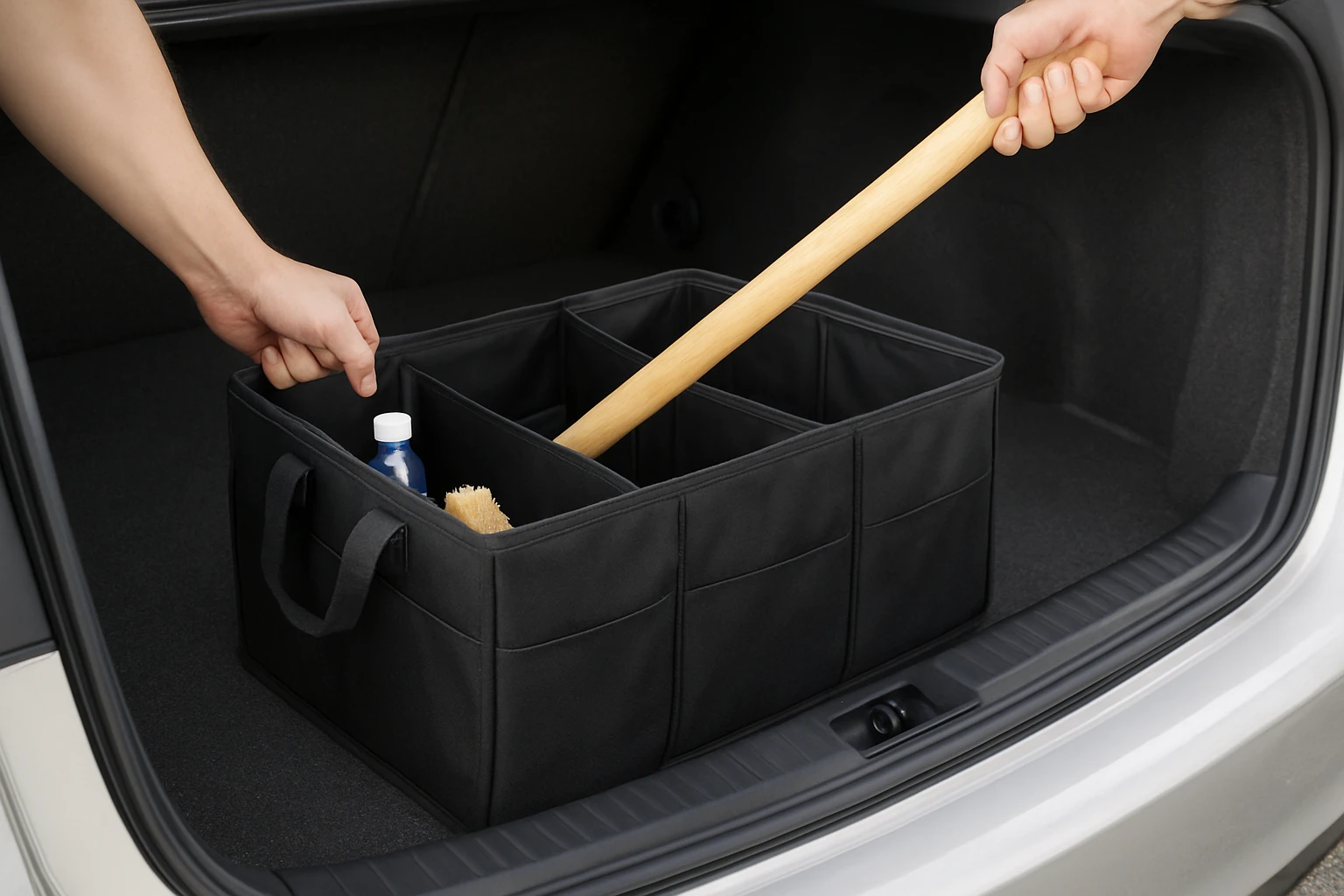
How to Crash-Test Your Trunk Organizer at Home: Step‑by‑Step DIY Method to Simulate Collisions Safely
One will discover how to evaluate the structural integrity of a trunk organizer without leaving the garage. The guide explains the scientific basis of impact testing, the equipment required, and the precise actions to perform a repeatable test. By following the method, one can compare the performance of different organizers and make an informed purchase decision. The information is valuable for anyone who relies on organized cargo space and wishes to avoid costly damage during everyday driving.
What You’ll Need
- Two sturdy trunk organizers for comparison – HOTOR Foldable Trunk Organizer with Cooler and FORTEM Collapsible Trunk Organizer
- Heavy‑duty plywood or a solid wooden board (minimum 3/4‑inch thickness) to serve as an impact platform
- Two sets of 2‑inch rubber pads to protect the floor and reduce noise
- Adjustable straps or ratchet tie‑downs to secure the organizer during impact
- Digital kitchen scale (capacity at least 30 kg) to measure load before testing
- High‑speed camera or a smartphone capable of 120 fps video recording
- Safety goggles, ear protection, and a fire‑resistant work blanket
- Measuring tape, marker, and a notebook for data collection
Step 1: Prepare a Safe Test Area
One should select an open, level concrete surface away from pedestrian traffic. The area must be free of obstacles, and a fire‑resistant blanket should be spread to catch any debris. Mark a 2‑meter straight line on the floor using tape; this line will define the travel path of the impact platform. Ensure that local regulations permit the use of a weighted drop weight in the chosen location.
Step 2: Gather Materials and Safety Gear
Before assembling the test rig, one must don safety goggles, ear protection, and gloves. The heavy‑duty plywood will act as a rigid platform that mimics the floor of a vehicle trunk. Place rubber pads at each end of the marked line to absorb the final impact and protect the platform. The digital kitchen scale will be used to verify that the load placed inside the organizer does not exceed typical cargo weights (approximately 20 kg).
Step 3: Build a Simple Impact Platform
Secure the plywood board to two sturdy wooden blocks that act as supports, creating a short “bridge” that can be released. Attach a release latch at the high end of the bridge; this latch will hold the board until the test begins. The board must be level so that gravity provides a consistent acceleration during the drop. For added realism, one can line the underside of the board with a thin sheet of metal to simulate the metal floor of a vehicle.
Step 4: Position the Trunk Organizer
Place the HOTOR Foldable Trunk Organizer with Cooler on the platform, aligning it with the marked line. The HOTOR model offers 69 L of main storage plus a 23 L insulated cooler bag, making it a representative heavy‑load organizer. Its reinforced Oxford cloth, thickened base panel, and sturdy handles provide a realistic test subject for durability. Use the adjustable side Velcro strips to expand the organizer to its full 30.90” × 12.60” × 10.63” size, ensuring the test reflects maximum stress conditions.
Secure the organizer with adjustable straps, tightening them so that the unit does not shift during the impact. The straps simulate the way a vehicle’s tie‑down points hold cargo in place during sudden braking. Record the weight of a typical load (e.g., a 15‑kg bag of groceries) using the digital scale and place it inside the cooler compartment to replicate real‑world usage.
Step 5: Simulate a Low‑Speed Collision
One will raise the impact platform to a height of 0.5 meters, which corresponds to a low‑speed collision of approximately 30 km/h when the board is released. The physics behind this calculation is based on the conversion of potential energy (m g h) to kinetic energy (½ m v²). Release the latch, allowing the board to slide down the marked line and strike the rubber pad at the far end. Record the event with the high‑speed camera to capture deformation, strap tension, and any displacement of the organizer.
Step 6: Observe and Record Results
After the impact, inspect the HOTOR organizer for any tears, seam separation, or deformation of the cooler bag. The product’s leak‑proof, waterproof insulated cooler is a critical component; a compromised seal indicates a failure under impact stress. Measure any shift in the organizer’s position using the measuring tape, and note the angle of any tilt. Document the observations in the notebook, including timestamps from the video for reference.
Step 7: Evaluate Performance and Compare Alternatives
If the HOTOR organizer maintains structural integrity, one can conclude that its premium Oxford cloth and reinforced stitching provide sufficient protection for everyday driving conditions. However, for a comparative analysis, repeat the entire procedure with the FORTEM Collapsible Trunk Organizer. The FORTEM model features a rigid base plate design and non‑slip strips that may behave differently under the same impact force. Compare the two sets of data: note any differences in deformation, strap slippage, and post‑impact stability.
The FORTEM organizer is priced at $27.99 and holds a rating of 4.7/5.0 from over 50,000 reviews, indicating strong consumer confidence. Its 600D Oxford fabric and interlocking buckles provide a modular approach that some users prefer for flexible storage. By contrasting the two products, one can determine whether the additional cooler functionality of the HOTOR model justifies its slightly higher price of $29.98.
Tips & Pro Tips
- Always conduct the test on a non‑slippery surface to prevent uncontrolled sliding of the platform.
- Use a fire‑resistant blanket to contain any debris that may break loose from the organizer.
- If a high‑speed camera is unavailable, a smartphone set to slow‑motion mode (120 fps) can still capture useful footage.
- Repeat the test at three different heights (0.3 m, 0.5 m, 0.7 m) to assess performance across a range of impact energies.
- When testing the cooler bag, fill it with ice packs to simulate real‑world temperature retention requirements.
Troubleshooting
Problem: The impact platform slides off the marked line before striking the pad.
Solution: Add additional non‑slip strips to the underside of the plywood or increase the weight of the platform by placing sandbags on the opposite end.
Problem: The organizer shifts despite the straps.
Solution: Tighten the straps further and use additional ratchet tie‑downs at the corners to distribute force evenly.
Conclusion
One now possesses a repeatable, low‑cost method to evaluate the crash‑worthiness of trunk organizers in a home environment. By following the steps, gathering accurate data, and comparing the HOTOR Foldable Trunk Organizer with Cooler to the FORTEM Collapsible Trunk Organizer, one can make a data‑driven decision about which product best meets durability and functionality requirements. The guide encourages readers to apply the same methodology to any future storage solutions, thereby ensuring long‑term safety and organization within their vehicles.
Products Mentioned in This Guide
Frequently Asked Questions
What equipment is needed to perform a DIY trunk organizer crash test?
You need two trunk organizers, a 3/4‑inch thick plywood board, 2‑inch rubber pads, and adjustable straps or ratchet tie‑downs.
How does the impact platform protect my garage floor during testing?
The plywood board distributes force while the rubber pads cushion the surface, preventing scratches and reducing noise.
Can I repeat the crash test to compare different organizers?
Yes, using the same setup and drop height lets you perform repeatable tests for direct performance comparison.
Is the DIY crash test safe for the organizer and surrounding area?
When secured with straps and performed on a stable platform, the test safely simulates collision forces without damaging the garage.
What does a successful crash test indicate about a trunk organizer?
It shows the organizer can withstand impact without collapsing, indicating better durability for everyday driving.