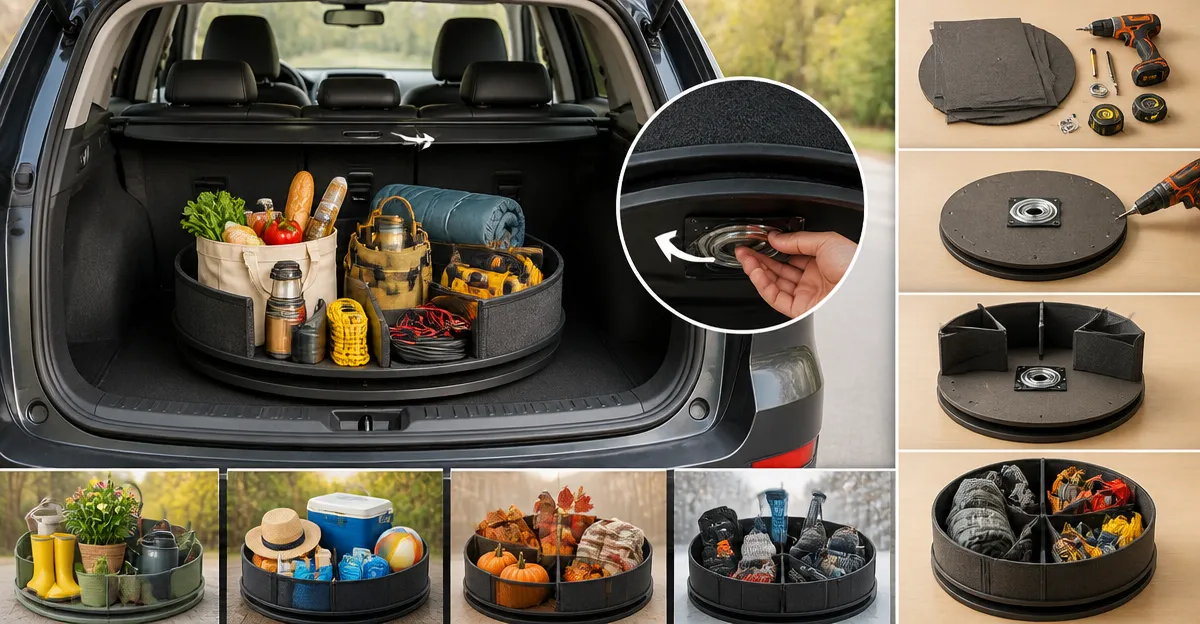
How to Build a Rotating Seasonal Trunk Organizer: Step‑by‑Step DIY System to Keep Your Car Organized Year‑Round
Introduction
Every driver encounters the frustration of a cluttered trunk after a grocery run, a camping trip or a seasonal garage sale. A rotating seasonal trunk organizer provides a structured solution that adapts to changing storage needs without requiring permanent modifications to the vehicle. This guide explains how to assess space, select the appropriate base organizer, integrate a smooth rotating mechanism and customize compartments for each season. By following the instructions, one will create a reusable system that maximizes trunk capacity, protects delicate items and reduces the time spent searching for misplaced objects.
The method described relies on readily available products, simple hand tools and basic carpentry techniques. Although the guide references specific Amazon items, the principles are applicable with alternative supplies. Readers who prefer a minimalist approach may omit optional accessories while still achieving a functional rotating organizer.
What You’ll Need
- Base organizer with sturdy construction – HOTOR Trunk Organizer (price $9.99, rating 4.6/5)
- Secondary organizer for additional compartments – Femuar Car Trunk Organizer (price $9.99, rating 4.7/5)
- Heavy‑duty rotating platform (lazy‑Susan style) – can be sourced from a hardware store or repurposed from a kitchen turntable.
- Non‑slip adhesive strips – included with many organizers, but extra strips can be purchased if needed.
- Adjustable straps or bungee cords for securing the system.
- Velcro tape for modular inserts.
- Label maker or printable tags for seasonal identification.
- Basic tools: screwdriver, utility knife, measuring tape, marker.
Step 1: Assess Space and Define Seasonal Zones
Begin by measuring the interior dimensions of the trunk, noting width, depth and height at the narrowest points. Record these figures in centimeters for precision. Next, divide the trunk lengthwise into three zones: winter, spring/summer and fall. Each zone will correspond to a set of items that are used predominantly during that season, such as snow shovels, beach towels or gardening tools.
Sketch a simple layout on paper, indicating where the rotating platform will sit and how each zone will align with the platform’s rotation points. This visual plan ensures that the organizer will not interfere with the spare tire, fuel door or rear seatback when the vehicle is fully loaded.
Step 2: Choose a Base Organizer
The foundation of the rotating system is a robust, collapsible organizer that can bear the weight of seasonal gear. The HOTOR Trunk Organizer offers two large compartments, six mesh pockets and a reinforced base capable of supporting over 60 lb. Its Oxford cloth construction resists wear, while the side Velcro strips allow the unit to be folded flat when not in use.
Why this product is suitable:
- Spacious compartments accommodate bulkier winter items such as blankets and sleds.
- Mesh pockets provide quick access to small tools, first‑aid kits and seasonal accessories.
- The collapsible design frees trunk space for larger loads after the rotating platform is installed.
Place the HOTOR organizer on the floor of the trunk, aligning its base with the center of the future rotating platform. Secure it temporarily with the included handles to prevent movement during the next steps.
Step 3: Install the Rotating Mechanism
Purchase a heavy‑duty lazy‑Susan turntable rated for at least 80 lb, or fabricate a rotating base using two circular plywood discs and a central bearing. Position the turntable directly beneath the HOTOR organizer, ensuring that the organizer’s base rests evenly on the rotating surface.
Secure the turntable to the trunk floor using the adjustable straps supplied with the Femuar Car Trunk Organizer. The Femuar model includes reinforced handles and a non‑slip Velcro bottom, which can be repurposed to anchor the turntable and prevent unwanted sliding during acceleration or braking.
Test the rotation by turning the platform through a full 360 degrees. The motion should be smooth and require minimal effort. If the turntable wobbles, add additional non‑slip strips beneath the bearing to increase friction with the trunk floor.
Step 4: Add Divider Panels and Mesh Pockets
To separate seasonal zones on the rotating platform, attach lightweight divider panels made from thin plywood or sturdy cardboard. Cut the panels to the width of the organizer and secure them with Velcro tape so that they can be repositioned as storage needs evolve.
For additional visibility, integrate mesh pockets from the HOTOR Trunk Organizer or the Femuar Car Trunk Organizer. Both products feature stretchy mesh pockets that keep items in sight while allowing quick removal. Attach the pockets to the divider panels with Velcro loops, creating a modular system that can be expanded or reduced without tools.
Example configuration:
- Winter zone – place a thick blanket in the lower compartment, store a snow brush in a mesh pocket, and keep a small shovel in a side pocket.
- Spring/Summer zone – allocate a water bottle holder, a beach towel roll and a portable cooler in the middle compartment.
- Fall zone – reserve space for gardening gloves, a small rake and seed packets in the upper compartment.
Step 5: Secure the System with Non‑Slip Strips and Straps
Even with a well‑balanced turntable, movement can occur during sharp turns. Apply the Velcro non‑slip bottom from the Femuar Car Trunk Organizer to the perimeter of the rotating base. This adhesive surface grips the trunk floor, reducing lateral shift.
Wrap adjustable straps around the organizer and anchor them to the trunk’s built‑in tie‑down points. The FORTEM Trunk Organizer includes built‑in straps that can be repurposed for this purpose; its non‑slip strips and sturdy 600D Oxford fabric provide additional stability for heavier loads.
When the straps are tightened, the entire assembly behaves as a single unit, preventing individual compartments from sliding independently and protecting delicate items from impact.
Step 6: Label and Customize for Each Season
Effective organization relies on clear identification. Use a label maker or printable tags to mark each compartment with the corresponding season. Attach the labels to the exterior of the organizer’s compartments and to the divider panels. This visual cue allows anyone who accesses the trunk to locate items without opening every pocket.
Consider adding color‑coded fabric patches—red for winter, green for spring/summer and orange for fall—to enhance quick recognition. These patches can be sewn onto the organizer’s handles or Velcro‑secured to the side panels.
Step 7: Test Load Capacity and Adjust
Before finalizing the system, load each compartment with representative seasonal items and rotate the platform several times. Observe whether the turntable maintains alignment and whether the straps remain taut. If the organizer sags, replace the base with the Amazon Basics Trunk Organizer, which offers a reinforced structural frame designed to prevent sagging under full load.
Key specifications of the Amazon Basics model include a 13.5‑gallon capacity, multiple customizable sections and heavy‑duty construction that resists collapse. Its professional construction makes it an excellent backup for high‑weight scenarios such as transporting sports equipment or emergency supplies.
After confirming smooth rotation and secure fastening, the rotating seasonal trunk organizer is ready for everyday use.
Tips & Pro Tips
- Periodically inspect Velcro strips for wear; replace them if the adhesive loses grip.
- When transporting liquids, place them in sealed containers and store them in the lower compartment to lower the center of gravity.
- Use the removable lid of the FORTEM Trunk Organizer to conceal valuable items such as tools or electronics.
- For added security, install a thin rubber mat beneath the turntable to dampen vibrations on rough roads.
- Rotate the organizer to the appropriate seasonal zone before each major trip to avoid unnecessary searching.
Troubleshooting
Problem: The platform wobbles after loading heavy items.
Solution: Reinforce the base with an additional plywood disc and re‑apply non‑slip strips to both the turntable and the trunk floor.
Problem: Mesh pockets tear under weight.
Solution: Distribute heavy objects across multiple pockets and use the reinforced handles of the HOTOR Trunk Organizer to carry bulkier items.
Problem: Straps loosen during long drives.
Solution: Replace standard bungee cords with the heavy‑duty straps included with the FORTEM Trunk Organizer, which feature adjustable buckles that maintain tension.
Conclusion
By assessing trunk dimensions, selecting a sturdy base organizer, installing a reliable rotating platform and customizing compartments with mesh pockets and divider panels, one can create a versatile seasonal trunk organizer that adapts to changing storage demands. The system enhances safety, reduces clutter and saves valuable time when loading or unloading the vehicle. Readers are encouraged to implement the steps outlined, experiment with the suggested products and refine the configuration to suit personal preferences.
Products Mentioned in This Guide
Frequently Asked Questions
What is a rotating seasonal trunk organizer and how does it work?
It is a DIY storage system that spins within the trunk, letting you flip between seasonal compartments without permanent modifications.
Which tools and materials are needed to build a rotating trunk organizer?
Basic hand tools, a sturdy base organizer, a smooth rotating mechanism (e.g., lazy‑Susan bearing), and optional dividers or fasteners.
How do I choose the right base organizer for my car’s trunk space?
Measure your trunk dimensions, then select a rigid organizer that fits snugly and can support the weight of your items.
What are the steps to install the rotating mechanism securely?
Attach the bearing to the base organizer, secure it to the trunk floor with brackets or adhesive, then test rotation before adding compartments.
Can the rotating trunk organizer be customized for different seasons or removed when not needed?
Yes, you can add or swap modular bins for each season and detach the whole unit for cleaning or when extra trunk space is required.