The Ultimate Guide: How to Optimize Trunk Weight Distribution to Maximize Your EV's Range
Introduction
Electric vehicle (EV) owners frequently seek ways to increase the distance that can be traveled on a single charge. One often overlooked factor is the distribution of weight within the trunk. This guide explains the physics behind weight distribution, outlines practical strategies, and recommends two high‑quality trunk organizers that can help maintain balance while keeping cargo secure. Readers will learn how to assess their load, select appropriate accessories, and implement best‑practice habits that collectively improve range efficiency.
The information presented combines scientific principles with real‑world examples, ensuring that both new and experienced EV drivers can apply the recommendations immediately. By the end of the article, the audience will possess a clear roadmap for organizing cargo, selecting the right tools, and avoiding common pitfalls that reduce range.
Background and Context
Range loss in an EV is primarily caused by increased rolling resistance, aerodynamic drag, and higher energy consumption from the drivetrain. When cargo is placed unevenly, the vehicle’s suspension and tires experience additional strain, which amplifies rolling resistance. Moreover, a poorly balanced load can shift the center of gravity, causing the vehicle to handle less predictably and requiring the powertrain to work harder during acceleration and braking.
Understanding the concepts of center of gravity, load path, and weight transfer is essential. The center of gravity is the point where the vehicle’s mass is evenly distributed in all directions. When heavy items are positioned far behind the rear axle, the rear suspension compresses, increasing tire deformation and rolling resistance. Conversely, placing weight too far forward can overload the front tires and affect steering efficiency.
Modern EVs often incorporate regenerative braking, which can partially recover energy lost during deceleration. However, if the vehicle is constantly fighting an unbalanced load, the regenerative system cannot fully compensate. Therefore, optimizing trunk weight distribution directly contributes to extending the usable range per charge.
Key Concepts for Effective Weight Distribution
Three core concepts guide the process of achieving optimal trunk balance:
- Center of Gravity Alignment: Aim to keep the combined center of gravity as close to the vehicle’s geometric center as possible. This minimizes uneven tire loading.
- Even Lateral Distribution: Distribute weight equally from left to right to prevent side‑to‑side torque that can cause uneven tire wear.
- Secure Attachment: Ensure that cargo does not shift during motion, as movement can temporarily alter the center of gravity and increase drag.
Applying these principles requires both strategic placement of items and the use of accessories that keep objects stable. The following sections detail how to implement each concept in practice.
Strategic Placement of Cargo
When loading an EV, the driver should follow a systematic approach:
- Heaviest Items First: Position the heaviest objects directly above or slightly in front of the rear axle. This location reduces rear‑end sag and maintains a balanced vertical load.
- Medium‑Weight Items: Place medium‑weight items toward the center of the trunk floor, ensuring they are centered laterally.
- Light and Fragile Items: Store lighter or delicate items on top, using compartments or dividers to prevent movement.
- Avoid Overhanging Loads: Keep cargo within the trunk’s boundaries to preserve aerodynamic shape and prevent wind resistance.
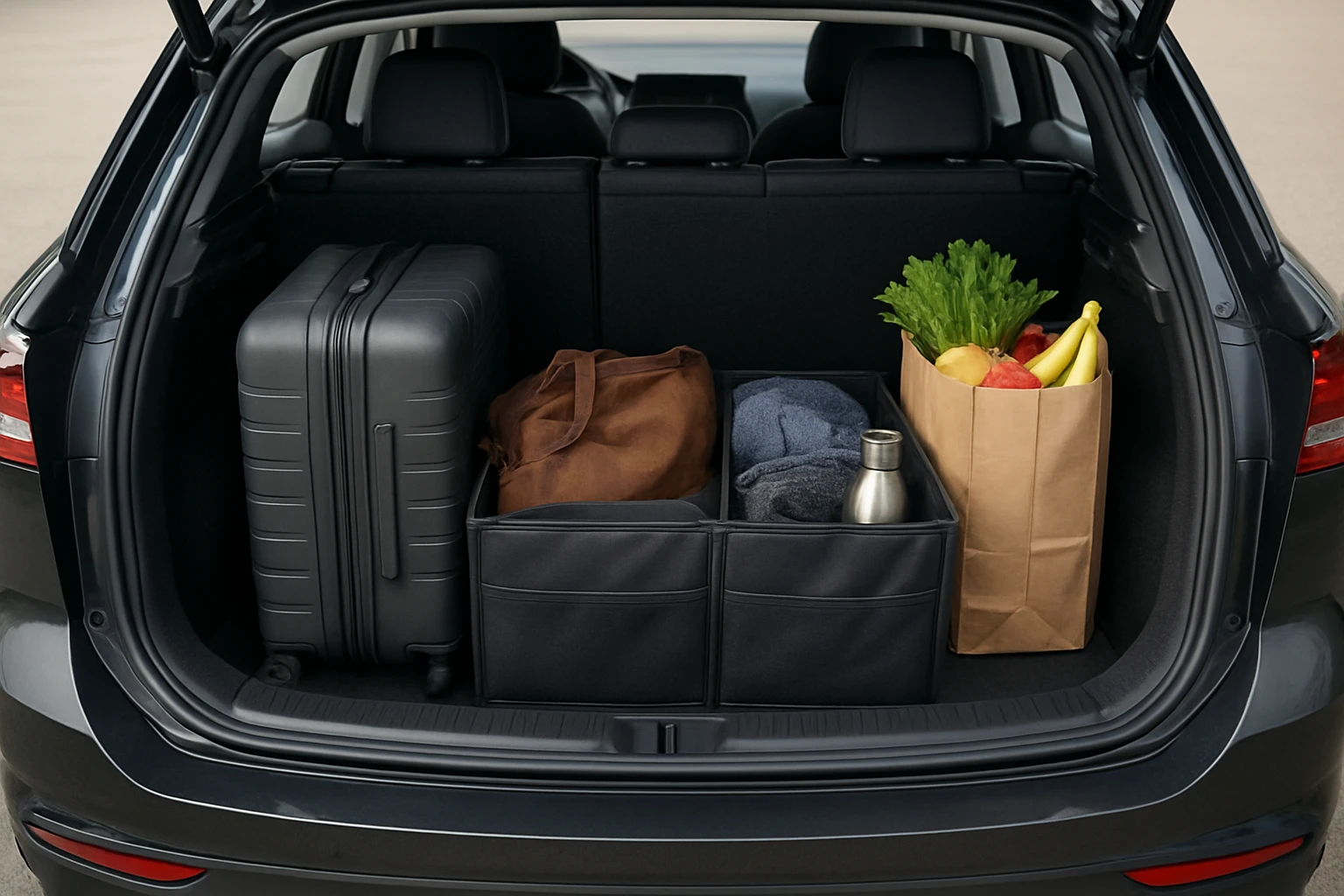
For example, a family traveling with groceries, sports equipment, and a portable cooler should load the grocery bags (heaviest) near the rear axle, the sports gear (medium) in the central zone, and the cooler (light) on top of a divider. This arrangement respects the three core concepts and reduces the energy required to move the vehicle.
Utilizing Trunk Organizers for Balance and Security
Organizers not only keep items tidy but also provide structural support that prevents shifting. Two products stand out for EV owners seeking both organization and weight‑distribution benefits.
The first recommendation is the HABOPET Collapsible Car Trunk Organizer. This organizer offers a 52‑liter capacity, two large compartments, and four mesh pockets that can hold heavy grocery bags close to the rear axle. Its durable 600D Oxford cloth and removable reinforcement plates add rigidity, ensuring that the load remains stable during acceleration and cornering.
The second recommendation is the EAROND Trunk Organizer with Cooler. In addition to three adjustable compartments, this model includes a leak‑proof insulated cooler bag, which can be positioned centrally to balance temperature‑sensitive items without adding excessive weight. The organizer’s 1680D waterproof Oxford cloth and built‑in non‑slip strips secure the cargo, reducing lateral movement.
Both organizers feature collapsible designs, allowing drivers to adjust the interior volume based on the amount of cargo. By selecting the appropriate size and securing the organizer with its built‑in straps, the driver can maintain an even weight distribution while keeping the trunk space organized.
Comparison and Selection Guide
Choosing the right organizer depends on the driver’s specific needs. The table below compares the two featured products across key criteria.
| Feature | HABOPET Collapsible Car Trunk Organizer | EAROND Trunk Organizer with Cooler |
|---|---|---|
| Capacity | 52 L (22.5×13×10.8 in) | Not specified; includes separate cooler bag |
| Compartment Layout | 2 large compartments, 4 mesh pockets, 2 front pockets | 3 adjustable compartments, 6 side/flap pockets, removable cooler |
| Material | 600D Oxford cloth, waterproof | 1680D waterproof Oxford cloth with PE board reinforcement |
| Weight‑Stability Features | Reinforcement plates, thickened curved handles | Non‑slip strips, securing straps, removable cooler bag |
| Price | $11.99 | $45.99 |
| Rating (reviews) | 4.6/5 (353 reviews) | 4.6/5 (1,379 reviews) |
| Best For | Budget‑conscious drivers needing basic organization | Drivers who require integrated cooling and higher durability |
For drivers who prioritize cost and need a simple, collapsible solution, the HABOPET organizer offers excellent value. For those who frequently transport perishable goods or require additional structural reinforcement, the EAROND organizer provides integrated cooling and stronger anti‑slip mechanisms.
Best Practices & Tips Beyond Products
Even with the best organizer, drivers should follow these supplemental practices to maximize range:
- Pre‑Trip Load Assessment: Weigh each item before loading and record the total cargo weight. Aim to keep the added weight below 10 % of the vehicle’s curb weight for optimal efficiency.
- Use Soft‑Side Cargo Nets: When items cannot fit into compartments, secure them with cargo nets that attach to anchor points in the trunk.
- Regularly Inspect Tire Pressure: Properly inflated tires reduce rolling resistance, which becomes more pronounced with added cargo.
- Limit Unnecessary Items: Remove items that are not essential for the journey; every kilogram influences energy consumption.
- Utilize Regenerative Braking Settings: Some EVs allow drivers to adjust regenerative braking strength; a higher setting can recoup more energy when descending hills, offsetting the drag from cargo.
By integrating these habits with a well‑chosen organizer, drivers can achieve a measurable increase in range—often between 3 % and 7 % depending on load size and driving conditions.
Frequently Asked Questions
- 1. Does the weight of a trunk organizer itself affect EV range?
- The organizer adds a modest amount of weight, typically under 2 kg. While any additional mass reduces efficiency slightly, the benefit of preventing cargo shift outweighs the minimal penalty.
- 2. How often should I reposition cargo on long trips?
- It is advisable to check cargo placement during scheduled stops, especially after steep descents or when the vehicle has traveled more than 200 km. Adjust if any items have shifted.
- 3. Can I use both organizers simultaneously?
- Yes, provided the combined volume does not exceed the trunk’s capacity. Using both can allow separation of heavy items (HABOPET) from temperature‑sensitive goods (EAROND cooler).
- 4. Are there any EV models that require special consideration for trunk loading?
- Vehicles with rear‑mounted batteries, such as the Tesla Model 3, have a lower rear‑axle load capacity. In such models, placing heavier items slightly forward of the axle is recommended.
- 5. Does a cooler bag increase energy consumption significantly?
- A well‑insulated cooler adds minimal weight. The primary impact is the thermal load if ice is used, which can marginally increase cabin heating demands in cold climates.
- 6. How do I clean the organizers without damaging them?
- Both products are waterproof Oxford cloth. Spot‑clean with a mild detergent and a damp cloth; allow to air‑dry completely before reuse.
- 7. Is there a maximum cargo weight that should never be exceeded?
- Manufacturers specify a maximum payload for each vehicle model. Exceeding this limit can impair suspension, braking, and overall efficiency. Consult the vehicle’s owner manual for the exact figure.
Conclusion
Optimizing trunk weight distribution is a practical, cost‑effective method for extending an electric vehicle’s range. By understanding the physics of center of gravity, applying strategic cargo placement, and employing reliable organizers such as the HABOPET Collapsible Car Trunk Organizer or the EAROND Trunk Organizer with Cooler, drivers can maintain balance, reduce rolling resistance, and improve overall efficiency. Coupled with regular maintenance habits, these steps enable EV owners to travel farther on each charge while preserving vehicle performance.
Products Featured in This Guide
HABOPET Collapsible Car Trunk Organizer
Price: $11.99
Rating: 4.6/5 (353 reviews)
Featured because it provides a spacious 52 L capacity, waterproof 600D Oxford cloth, and reinforcement plates that keep heavy cargo stable, directly supporting balanced weight distribution.
EAROND Trunk Organizer with Cooler
Price: $45.99
Rating: 4.6/5 (1,379 reviews)
Featured because it combines adjustable compartments with a leak‑proof insulated cooler, offering both durability and temperature control for perishable cargo while maintaining a balanced load.